Items
Search full-text
Riverside
-

Citrus Project Interview
Anonymous interviewee describes her lifelong relationship with labor beginning in Mexico at the age of thirteen, to migrating to the United States and setting as a sorter for the National Orange Company in Riverside. She describes the hardships of labor in packinghouses, wages, supervisors, and her aspirations for a better job. -
Steve Solis interview, Tape 1
Steve Solis discusses his family history in Riverside as well as working as a house manager in the National Orange Company Packing House and what his position encompasses. -
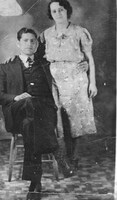
Mr. and Mrs. Hernandez
Mr. and Mrs. Hernandez stand posing for a portrait photo. Tony is seated and his wife is standing beside him. -
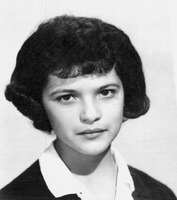
Portrait of Lucille Hernandez-Ortiz
Black and white portrait of Lucille Hernandez-Ortiz. -
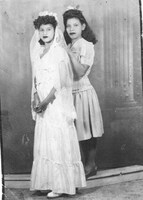
Toti Lozano
Toti Lozano stands posing in what appears to be her wedding gown. Another person in formal wear stands behind her, with their hands on her shoulders. -

Anthony Victoria
Margaret Razo is a longtime Bloomington, California resident who moved to the area in 1973 from Riverside. She narrates her family history and experiences in the originally rural area with tight-knit neighbors. She describes her upbringing and community involvement due to her father’s emphasis on making everyone feel included. Kessler Park was a staple of her childhood as she mentions get togethers and baseball games there. Over the years, industrialization begins to impact the once peaceful and simple area with an influx of warehouses and infrastructures that begin to displace lifelong residents, forcing them to relocate. Her concerns reveal the effects of warehouse and other industrial growth on well-established communities and the rural environment. -

Connie Confer Homegrown Heroes Full Interview
This is an oral history interview with Connie Confer, conducted on December 15, 2023. Connie, whose full name is Carolun Confer but is commonly known as Connie, shares her life story from her childhood in Milton, Pennsylvania, her family background, her education at Penn State where she majored in broadcasting and theater arts, and her career as a social worker, her path to law school, and later becoming an activist for LGBTQ rights with her long-term partner/wife Kay. -

Richard Fields Homegrown Heroes Full Interview
This is an oral history interview with Justice Richard T. Fields conducted on November 15, 2023. The interview covers his childhood memories from growing up in East St. Louis, Illinois and his experiences with racial discrimination growing up in a racially segregated community. His interview also covers the impact of his role in the community from being a lawyer to become the Associate Justice on the California Court of Appeal, Fourth Appellate District, Division Two. -

Elvis Zornoza Homegrown Heroes Full Interview
This interview with Elvis Zonoroza was conducted on July 12, 2024. The interview covers Elvis's earlier life memories within Mexico and America, and the challenges he faced as a deaf individual. These include challenges with communication with other people and the challnges in aclimating to the new lifestyle he experienced when arriving in the US from Mexico. Elvis discusses his education at the California School of the Deaf. After his highschool graduation at CSDR, Elvis innitially sought to persue a cereer in Physical Education, and so he attended Galaudat University in Washington D.C, but had to leave early due to becoming a young father. Elvis recalls his experience first working with community advocacy, which gave him a new perspective on how to help deaf people. After graduation, he got a job as an ASL instructor at the Holy Names Highschool in Oakland which gave him a more in depth understanding behind ASL and its intricacies. Later on down the line, Elvis worked in the Center on Defeness in the Inland Empire (CODIE) where he advocated on behalf of others with the same condition as he. He advocated for their employment, education, and accimation and acceptance within communities. He continues to advocate using his youtube channel which focuses on sports and sports education as well as deaf education. -

Vivian Stancil Homegrown Heroes Full Interview
This interview with Vivian Stancil was conducted on May 7, 2024. Vivian shares her life story, including her challenging childhood in foster care, her diagnosis of retinitis pigmentosa (RP) that led to vision loss, and her perseverance in pursuing education and becoming a teacherin Long Beach. After retiring from teaching, Vivian was told by her doctor that she would not live to 60 if she did not make significant life changes. From that point, Vivian made a major life style change through swimming as a sport. Through her love for swimming, Vivian dedicated herself to community service, founding two non-profit organizations - Christian Intercessors of the Nations and the Vivian Stancil Olympian Foundation. The Olympian Foundation focuses on drowning prevention, providing free swimming lessons and water safety education, especially for underprivileged children and adults. Vivian herself learned to swim as an adult and went on to compete in the Senior Olympics, winning numerous medals. -

Ben Jauregui Homegrown Heroes Full Interview
This interview with Ben Jáuregui was conducted on December 12, 2023. In this interview, Jáuregui shares his upbringing as a child of migrant farmworkers, and how witnessing their challenges eventually led and inspired him to become a disability rights advocate. After taking sign language classes in high school and volunteering at a disability advocacy organization, Jáuregui discusses his work at the Inland Empire Health Plan where he helped make healthcare more accessible for people with disabilities. Jáuregui also talks about his leadership roles in initiatives like the Inland Empire Disabilities Collaborative and the Inland Coalition on Aging, which aim to improve services and support for seniors and individuals with disabilities in the IE. -

Phyllis Clark Homegrown Heroes Full Interview
This interview with Phyllis Clark was conducted on May 10, 2024. Clark is the founder and CEO of the Healthy Heritage movement, a non-profit organization focused on eliminating health disparities in the African American community. In this interview, Clark shares her experience growing up in a military family, her educational career in fashion and business, and how that eventually transitioned into health advocacy work. Through the Healthy Heritage Movement, Clark shares more about programs like Broken Crayons Still Color that showcase a holistic approach to health advocacy amongst the African American community. -

Close up of Congregation of St. Mark's Missionary Baptist 1940s
Formal portrait of congregation members from St. Mark's Missionary Baptist Church, with men in suits and women in Sunday best and hats probably from late 1940s. We do not yet have identification for individual congregation members. On Back: C.W. McLaughlin 943 No Riverside Ave Rialto California -

World Wide Guild Group at St. Mark's Baptist Church
World Wide Guild Group, a women's missionary group, standing in a line for a photo in front of the exterior of the first St. Mark's Baptist Church building. Imogene McMurray is 4th from the right. Other members as yet unidentified. The inscription on the bottom of the image reads "World Wide Guild Group, St. Mark Baptist Church, Edw. Streeter Photo." The back reads "Edward D Streeter Photo 4361 Grove Ave. Riverside Calif. Tel 4949" -
Henry Vasquez 2024.001.019
Henry Vasquez recounts his experiences as a teacher for several schools in the San Bernardino area, as well as the challenges his community was forced to overcome. Henry is Chicano, and is well connected with the Native American communities near his area. In his time, the state attempted to discourage bilingual education in an attempt to assimilate natives and immigrants. He, as well as several of his collegues, protested this change, and such attempts eventually halted. Henry advocates for the opening of more Indian Centers so that members of the Native communities can be better educated to fix the problems around them. He also criticizes the encroachment of warehouses on his community due to community concerns of pollution. -
Chani Beeman Oral History
Chani Beeman discusses the overlaps between and intersectionality of the LGBTQ community, women’s rights, and the empowerment of people of color. She discusses her family life, and that by the time she started college, she had two young children and had gotten remarried. She describes her exposure to the LGBTQ community during the 1980s AIDS crisis, and coming out when she was 28 years old. She mentions pressure from her family to conform to a more heteronormative lifestyle. While Chani Beeman was at Cal State San Bernardino, she became politically active and was openly gay. She describes her involvement in the socialist organization Solidarity, which emphasized the intersectionality of women’s rights, socialism, and anti-war movements. Chani Beeman also discusses her involvement in the Inland AIDS Project and Women Enraged! She shares details about her many collaborations and community organizing with other regional groups, commonly around social justice. She describes her involvement after the brutal murder of Nancy Willem in actions led by Women Enraged, including the Clothesline Project which brought attention to violence against women. Beeman also describes Women Enraged’s guerrilla theater, which included street demonstrations; other examples she offers include how WE wrote statistics about violence against women on dollar bills and distributed them in public. One of the slogans on the bills was “Stop sucking, start biting”. She is an active community organizer and member. -
Lupe Sanchez Band, 1964
Color photograph of the Lupe Sanchez Band with Blas Coyazo on guitar; Hemet Califorina, New Year's Eve 1964. Blas Coyazo said: "I play the bass guitar and the electric guitar and the electric guitar so for the last fifty years also, or more, out of the eighty-three years that I have, I've been playing with bands in the Inland Empire here. San Bernardino, Colton, Riverside, Hemet, Palm Springs, even Indio and Coachella, Perris, Pomona, Fontana, Bloomington, Corona...Saturday nights I used to go out moslty every week and earn perhaps twenty, twenty-five dollars extra...So I made that as a side work, you know, because I'd -- well, I learned how to play the guitar way back in 1927, '28." -
Anthony Victoria Oral History 2
Anthony Victoria shows the location of and discusses the BNSF intermodal facility in San Bernardino. He speaks about the company’s plans to expand into neighboring communities, and the reasons behind why some people sell their homes to the company while others are unable to, as well as the history of workers of color being exploited by industry in the inland empire. He mentions his own personal history with the pollution and environmental racism in the inland empire. -
Anthony Victoria Oral History 1
Anthony Victoria, an inland empire resident and enviromental justice advocate, discusses the railroad and warehouse industry in San Bernardino and the Inland Empire. He describes the pollution these industries put into the air, and the adverse effects pollution has on the communities of color where warehouses and railroads are built. He also advocates for a shift in the way the average person views their communities to become less consumer-driven and turn focus on decreasing emissions and challenging the large corporations exploiting their workforce. Efforts to reform the local laws and regulations in the Inland Empire, he argues, will allow for the betterment of air quality and force representatives to act in what is best for the communities, and not industry. -

Copy of Ana Carlos C0080
Ana Carlos continues to speak about the effects of warehouse expansion and companies buying up land in her town of Bloomington. She talks about homes being bought up and demolished to make room for warehouses and industrial parks. She also talks about how companies, such as Amazon, have made contributions to schools and promises to replace destroyed trees. These are attempts to gain support for their warehouses. However, Ana Carlos explains that these contributions won’t do much for Bloomington. Ana Carlos also recalls seeing similar warehouse expansion in Fontana and Riverside, all in the Inland Empire. Ana Carlos also comments on poor air quality affecting students' health, with increasing cases of Asthma. As well as the heat island effect caused by concrete. -
Ernest "Jimmy" Medina Interview
Ernest "Jimmy" Medina discusses his life growing up in the Inland Empire. Additionally, he discussed his father's involvement in the bracero program and the citrus industry. -

Lupe Sanchez Band, 1964
Color photograph of the Lupe Sanchez Band with Blas Coyazo on guitar; Hemet Califorina, New Year's Eve 1964. Blas Coyazo said: "I play the bass guitar and the electric guitar and the electric guitar so for the last fifty years also, or more, out of the eighty-three years that I have, I've been playing with bands in the Inland Empire here. San Bernardino, Colton, Riverside, Hemet, Palm Springs, even Indio and Coachella, Perris, Pomona, Fontana, Bloomington, Corona...Saturday nights I used to go out mostly every week and earn perhaps twenty, twenty-five dollars extra...So I made that as a side work, you know, because I'd -- well, I learned how to play the guitar way back in 1927, '28." -

Monrovia Day Street Parade
A black and white photo of the view of the street and spectators during the Monrovia Day parade in an unknown year. On the street is a girl sitting on top of a car and behind is a man riding a mule. There is a large palm tree on the sidewalk where the onlookers are. Stores on the street can be seen behind the spectators such as Kustner's Pharmacy, a jewel, a sign that says "Sontag" and another that states "Gabriel's," but these two signs are too small in the photo to read. -

Four Young Girls
Black-and-white photo of four young girls crouching down and looking at the camera. Three out of the four girls wear sun-hats and the fourth holds hers in her hands in front of her. Two of the girls are holding bundles of grapes. -

Senora Sotelo
Black and white photo of Señora Sotelo standing in her wedding gown.