Items
Search full-text
Riverside
-

Robert and Joe Venegas
Pictured are Joe Venegas (father) and Robert "Junie" Venegas (son). Robert was the eldest son of Joe Venegas and began working with him at the age of thirteen. Robert continued working in the groves until 1945 when he joined the army. The photograph's location is described to be a citrus grove located between Victoria Avenue and Nelson Street in Riverside, California. -

Joe and Ygnacia Venegas: Photograph
Photograph of married couple Joe Venegas and Ygnacia Hernandez Venegas. Ygnacia, from Chihuahua, Mexico, and Joe, from Mexicali, Mexico, met in Riverside. They raised seven children together: Molly, Robert, Rosa, Josie, Isabel, Joe, and Manuel. -

Braceros at L.V.W. Brown Estate
Photograph of braceros from the citrus industry working at the L.V.W. Brown Estate in Riverside, California. Pictured on the bottom left: Joe Venegas and Joe Venegas, Jr. During his time at L.V.W. Brown Estate, Joe Venegas gained a good reputation for being reliable, responsible, and a hard worker, furthering him to his promotion to foreman. He then continued to work in the citrus industry for fifty years. -

Interview with Citrus Packer Lupe Reyes
Lupe Reyes discusses her early life in Riverside, California, and her experience working as a packer in the citrus fruit industry. -
Steve Solis Interview, Tape 2
Interviewee Steve Solis discusses hardships and day-to-day routine working in the orange packing industry. -

Macias Family Interview by Leslie Rios in Beaumont (3 of 3)
Tape three of the Macias Family Interview. The family discusses the first lawsuit won against the Riverside police department in Beaumont, as well as conflicts with the police department. The interview also discuss financial aid and community activism. -

San Timoteo Canyon Schoolhouse Jim Velasquez Jerry Cody
One of five tapes discussing the San Timoteo Canyon Schoolhouse. Jim Velasquez discusses the history of the first indigenous peoples of the Inland Empire from the eighteenth, seventeenth, and nineteenth centuries respectively. Velasquez follows the indigenous history of Spain, Mexico, and the United States. -

Citrus Project Interview
Anonymous interviewee describes her lifelong relationship with labor beginning in Mexico at the age of thirteen, to migrating to the United States and setting as a sorter for the National Orange Company in Riverside. She describes the hardships of labor in packinghouses, wages, supervisors, and her aspirations for a better job. -
Steve Solis interview, Tape 1
Steve Solis discusses his family history in Riverside as well as working as a house manager in the National Orange Company Packing House and what his position encompasses. -

Oscar Colunga Oral History
Oscar Colunga shares his life story, starting from his birth during an unexpected snowstorm in San Bernardino, California in 1949. He delves into his family history, especially his parents’ life after the Second World War and their emigration to South Colton. He describes his childhood in a Mexican American neighborhood and the culture and society of the 1950s and 1960s. He reflects on his school days, recreational activities, and integration, especially during high school, and his participation in different activities outside school. He addresses aspects of his relatives work in the Colton Cement Plant (California Portland), the explosions at the mines he could hear and see from his house, and the ways the dust got into everything and worsened the air quality. Colunga makes keen points about the ways the dust caused health problems among family members, and the respiratory issues they faced. Colunga also talks about the progression of his career, resulting in his decision to move to Solvang, CA. Looking back at the changes in the decades he has been away, he explains how he wants to retire back to his hometown. -
Jose de Alejanro interviewed by Martha Olivera and Angela Gonzalez
1991 interview with Jose de Alejanro. Interviewed by Martha Olivera and Angela Gonzalez. Oral histories (1990-91) documenting social, business, and labor histories of the citrus industry in Southern California through interviews with owners, managers, and laborers of Riverside, National Orange Company (1898-2001), the oldest continuously operating packinghouse at the time. Interviews by UCR students and faculty, contributing to research towards development of an interpretive plan for California Citrus State Historic Park. -

Juventino Oliveros Interview
1990 interview with Juventino Oliveros. Oral histories (1990-91) documenting social, business, and labor histories of the citrus industry in Southern California through interviews with owners, managers, and laborers of Riverside, National Orange Company (1898-2001), the oldest continuously operating packinghouse at the time. Interviews by UCR students and faculty, contributing to research towards development of an interpretive plan for California Citrus State Historic Park. The latter half of the interview is inaudible. -
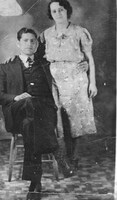
Mr. and Mrs. Hernandez
Mr. and Mrs. Hernandez stand posing for a portrait photo. Tony is seated and his wife is standing beside him. -
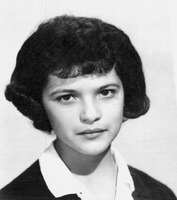
Portrait of Lucille Hernandez-Ortiz
Black and white portrait of Lucille Hernandez-Ortiz. -
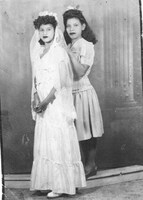
Toti Lozano
Toti Lozano stands posing in what appears to be her wedding gown. Another person in formal wear stands behind her, with their hands on her shoulders. -
Margaret Razo Oral History
Margaret Razo is a longtime Bloomington, California resident who moved to the area in 1973 from Riverside. She narrates her family history and experiences in the originally rural area with tight-knit neighbors. She describes her upbringing and community involvement due to her father’s emphasis on making everyone feel included. Kessler Park was a staple of her childhood as she mentions get togethers and baseball games there. Over the years, industrialization begins to impact the once peaceful and simple area with an influx of warehouses and infrastructures that begin to displace lifelong residents, forcing them to relocate. Her concerns reveal the effects of warehouse and other industrial growth on well-established communities and the rural environment. -

Connie Confer Homegrown Heroes Full Interview
This is an oral history interview with Connie Confer, conducted on December 15, 2023. Connie, whose full name is Carolun Confer but is commonly known as Connie, shares her life story from her childhood in Milton, Pennsylvania, her family background, her education at Penn State where she majored in broadcasting and theater arts, and her career as a social worker, her path to law school, and later becoming an activist for LGBTQ rights with her long-term partner/wife Kay. -

Richard Fields Homegrown Heroes Full Interview
This is an oral history interview with Justice Richard T. Fields conducted on November 15, 2023. The interview covers his childhood memories from growing up in East St. Louis, Illinois and his experiences with racial discrimination growing up in a racially segregated community. His interview also covers the impact of his role in the community from being a lawyer to become the Associate Justice on the California Court of Appeal, Fourth Appellate District, Division Two. -

Elvis Zornoza Homegrown Heroes Full Interview
This interview with Elvis Zonoroza was conducted on July 12, 2024. The interview covers Elvis's earlier life memories within Mexico and America, and the challenges he faced as a deaf individual. These include challenges with communication with other people and the challnges in aclimating to the new lifestyle he experienced when arriving in the US from Mexico. Elvis discusses his education at the California School of the Deaf. After his highschool graduation at CSDR, Elvis innitially sought to persue a cereer in Physical Education, and so he attended Galaudat University in Washington D.C, but had to leave early due to becoming a young father. Elvis recalls his experience first working with community advocacy, which gave him a new perspective on how to help deaf people. After graduation, he got a job as an ASL instructor at the Holy Names Highschool in Oakland which gave him a more in depth understanding behind ASL and its intricacies. Later on down the line, Elvis worked in the Center on Defeness in the Inland Empire (CODIE) where he advocated on behalf of others with the same condition as he. He advocated for their employment, education, and accimation and acceptance within communities. He continues to advocate using his youtube channel which focuses on sports and sports education as well as deaf education. -

Vivian Stancil Homegrown Heroes Full Interview
This interview with Vivian Stancil was conducted on May 7, 2024. Vivian shares her life story, including her challenging childhood in foster care, her diagnosis of retinitis pigmentosa (RP) that led to vision loss, and her perseverance in pursuing education and becoming a teacherin Long Beach. After retiring from teaching, Vivian was told by her doctor that she would not live to 60 if she did not make significant life changes. From that point, Vivian made a major life style change through swimming as a sport. Through her love for swimming, Vivian dedicated herself to community service, founding two non-profit organizations - Christian Intercessors of the Nations and the Vivian Stancil Olympian Foundation. The Olympian Foundation focuses on drowning prevention, providing free swimming lessons and water safety education, especially for underprivileged children and adults. Vivian herself learned to swim as an adult and went on to compete in the Senior Olympics, winning numerous medals. -

Ben Jauregui Homegrown Heroes Full Interview
This interview with Ben Jáuregui was conducted on December 12, 2023. In this interview, Jáuregui shares his upbringing as a child of migrant farmworkers, and how witnessing their challenges eventually led and inspired him to become a disability rights advocate. After taking sign language classes in high school and volunteering at a disability advocacy organization, Jáuregui discusses his work at the Inland Empire Health Plan where he helped make healthcare more accessible for people with disabilities. Jáuregui also talks about his leadership roles in initiatives like the Inland Empire Disabilities Collaborative and the Inland Coalition on Aging, which aim to improve services and support for seniors and individuals with disabilities in the IE. -

Phyllis Clark Homegrown Heroes Full Interview
This interview with Phyllis Clark was conducted on May 10, 2024. Clark is the founder and CEO of the Healthy Heritage movement, a non-profit organization focused on eliminating health disparities in the African American community. In this interview, Clark shares her experience growing up in a military family, her educational career in fashion and business, and how that eventually transitioned into health advocacy work. Through the Healthy Heritage Movement, Clark shares more about programs like Broken Crayons Still Color that showcase a holistic approach to health advocacy amongst the African American community. -

Close up of Congregation of St. Mark's Missionary Baptist 1940s
Formal portrait of congregation members from St. Mark's Missionary Baptist Church, with men in suits and women in Sunday best and hats probably from late 1940s. We do not yet have identification for individual congregation members. On Back: C.W. McLaughlin 943 No Riverside Ave Rialto California -

World Wide Guild Group at St. Mark's Baptist Church
World Wide Guild Group, a women's missionary group, standing in a line for a photo in front of the exterior of the first St. Mark's Baptist Church building. Imogene McMurray is 4th from the right. Other members as yet unidentified. The inscription on the bottom of the image reads "World Wide Guild Group, St. Mark Baptist Church, Edw. Streeter Photo." The back reads "Edward D Streeter Photo 4361 Grove Ave. Riverside Calif. Tel 4949" -
Henry Vasquez 2024.001.019
Henry Vasquez recounts his experiences as a teacher for several schools in the San Bernardino area, as well as the challenges his community was forced to overcome. Henry is Chicano, and is well connected with the Native American communities near his area. In his time, the state attempted to discourage bilingual education in an attempt to assimilate natives and immigrants. He, as well as several of his collegues, protested this change, and such attempts eventually halted. Henry advocates for the opening of more Indian Centers so that members of the Native communities can be better educated to fix the problems around them. He also criticizes the encroachment of warehouses on his community due to community concerns of pollution.