Items
Search full-text
colton
Spatial Coverage contains
Colton
-

Colton, Wilson Reunion
Interviewees attending the Wilson High School reunion recount their memories of Colton in their youth, the impact of the I-10 freeway on Colton, and their desires for the future of Colton's growth moving forward. -

Colton, Pascual Olivas Reunion (Part Two)
The second part of the Colton, Pascual Olivas Reunion. Dominic Philaseda recounts experiences as a musician. Angel Olivas recounts experiences in the military, the Second World War, the Post American Legion, discrimination, and benefits for Mexican Americans following the Second World War. -

Colton, Pascual Olivas Reunion
Rudy Olivas discusses his experience as a musician as well as the discrimination he witnessed in Colton, California throughout his life, including a sudden shift in attitude toward Mexican Americans following the Second World War. Rudy Oliva's wife, Julia Olivas, and grandchild, Joseph Kiones, discuss their lives and their experiences with music. -

Frank Acosta Oral History
Frank Acosta is a retired educator who worked as a junior high teacher for 41 years within the Colton Unified School District. He now serves as a member of the board at the Colton Area Museum, and as one of the three members of the South Colton Oral History Project. Frank grew up in City Terrace, East Los Angeles and moved to the Inland Empire to attend UC Riverside for college. In his interview, Frank shares his experience as an educator in the Colton School District, racial segregation in schools, and the impacts social and environmental impacts of the development of the railroad and later the freeways through the area. -
Ramona Arranda Genamaras Oral History
In her oral history interview, Ramona Arranda Genamaras shares the story of how her parents immigrated to the United States due to the expanding railroad in Southern California and job opportunities it presented. Ramona is the first born of her siblings, born in San Bernardino, CA, where they lived a few years before moving to South Colton. She recalls growing up in South Colton, attending segregated primary and elementary schools. While she spoke Spanish and English at home, she was expected to only speak English at school, something she remembers understanding without needing to be told. Throughout her years in school, some of her happiest years she recalls, she was very involved in activities and was often asked by her teachers to speak or perform at school events. She remained active in her children’s lives by joining the PTA and organizing the first Halloween carnival, where she sewed costumes for her children. Ramona worked in the garment industry for 15 years as a seamstress, a skill she picked up from her mother who sewed all of her and her siblings’ clothes. This was a practice Ramona herself continued with her own four daughters and one son. Ramona shares the lives of her parents, children, her love for baseball, celebrating her 99th birthday, and community life in South Colton, CA. -
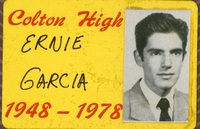
Ernie Garcia Colton High ID
Ernie Garcia ID from Colton High reunion -

Unknown man in South Colton
An unidentified young man standing on the sidewalk in South Colton. Behind him are old cars and the El Pano market. -

Victoria Colunga at a Colton Playground
Victoria Colunga (maiden name Saldivar) photographed at a park in South Colton. She is wearing an oversized blazer jacket and pants with her hair piled high on her head. The outfit is reminiscent of outfits worn by self proclaimed "Pachucas". -

Ray Abril Colton, CA
Ray Abril Jr. has a conversation with Antonio Vasquez about his life in Colton, Calif., including his experiences on the school board and how the city has changed over his lifetime. -
Oscar Colunga Oral History
Oscar Colunga shares his life story, starting from his birth during an unexpected snowstorm in San Bernardino, California in 1949. He delves into his family history, especially his parents’ life after the Second World War and their emigration to South Colton. He describes his childhood in a Mexican American neighborhood and the culture and society of the 1950s and 1960s. He reflects on his school days, recreational activities, and integration, especially during high school, and his participation in different activities outside school. He addresses aspects of his relatives work in the Colton Cement Plant (California Portland), the explosions at the mines he could hear and see from his house, and the ways the dust got into everything and worsened the air quality. Colunga makes keen points about the ways the dust caused health problems among family members, and the respiratory issues they faced. Colunga also talks about the progression of his career, resulting in his decision to move to Solvang, CA. Looking back at the changes in the decades he has been away, he explains how he wants to retire back to his hometown. -
Colton Story Share
Interviewees attest to experiencing severe racial tensions while residing in the Inland Empire. The I-10 freeway disrupted travel and life for many, while forcibly causing the IE to become more integrated with the rest of Southern California. Lastly, Mexicans were not allow to use clean public swimming pools, solely dirty ones. -

Sixteenth of September Queen and Court
The Queen and her court pose for a picture during the 16th of September festivities. The stage is decorated with American and Mexican flags, paper chains, palm fronds, and portraits of patriotic figures. The image belonged to Victoria Colunga (maiden name Saldivar) who was a runner up in the Queen contest, she is forth on the left. On the back is written "Sra Victoria Saldivar - H. Dama. Consirbelo como un recuerdo del 16 de sepbre. de 1945." On back is also a stamp "Comision Honorifica Mexicana - Colton Cal." -

Sixteenth of September Queen Float
The Queen and her court for the 16th of September festivities ride atop a float in a parade. The float is decorated with American and Mexican Flags. The image belonged to Victoria Colunga (maiden name Saldivar) who was a runner up in the Queen contest. On the back is written "Sra Victoria Saldivar - H. Dama. Consirbelo como un recuerdo del 16 de sepbre. de 1945." On back is also a stamp "Comision Honorifica Mexicana - Colton Cal." -

Colunga Family in Grand Terrace
Children, Oscar and Ruben Colunga, pose in matching outfits with an older relative and their mother Victoria Colunga (maiden name Saldivar), overlooking Colton from atop a hill in what is now called Grand Terrace. During the 1940s the family called this location "Jap Hill" as it was the place where Japanese citizens were held before being sent to internment camps across the state during World War II. In the background you can see the Cooley Ranch and into the valley. Part of the album "Jap Hill in Colton March 25, 1954." The family would often visit this spot for picnics and outings especially after church on Sundays. -

Victoria Colunga with Son Oscar
Victoria Colunga (maiden name Saldivar) leans against a car with son Oscar Colunga, behind them is the neighborhood of South Colton. Some women walk in the street illustrating the active community in the area. -

Oscar and Ruben Colunga with dog and unknown young man in Grand Terrace
Children, Oscar and Ruben Colunga, pose in matching outfits with an older relative and their family dog, overlooking Colton from atop a hill in what is now called Grand Terrace. During the 1940s the family called this location "Jap Hill" as it was the place where Japanese citizens were held before being sent to internment camps across the state during World War II. In the background you can see the Cooley Ranch and into the valley including Mount Slover in the background. Part of the album "Jap Hill in Colton March 25, 1954." The family would often visit this spot for picnics and outings especially after church on Sundays. -

Victoria Colunga in Grand Terrace
Victoria Colunga (maiden name Saldivar) stands atop a hill in Grand Terrace. During the 1940s the family called this location "Jap Hill" as it was the place where Japanese citizens were held before being sent to internment camps across the state during World War II. In the background you can see the Cooley Ranch, the Santa Ana River wash, Mount Slover and into the South Colton community. Part of the album "Jap Hill in Colton March 25, 1954." The family would often visit this spot for picnics and outings especially after church on Sundays. -

Oscar and Ruben Colunga in Grand Terrace
Children, Oscar and Ruben Colunga, pose in matching outfits overlooking Colton from atop a hill in what is now called Grand Terrace. During the 1940s the family called this location "Jap Hill" as it was the place where Japanese citizens were held before being sent to internment camps across the state during World War II. In the background you can see the Cooley Ranch and into the valley. Part of the album "Jap Hill in Colton March 25, 1954." The family would often visit this spot for picnics and outings especially after church on Sundays. -
Henry Vasquez 2024.001.018
In this interview, Henry Vasquez discusses his family history in Mexico and the U.S., changes in San Bernardino during his life, his observations of the people in South Colton, and the the encroachment of warehouses on the community of Bloomington, as well as the pollution that comes with them. He actively resists the increase of warehouses in the area, and shares his perspective as an Indigenous person from Mexico, addressing Native beliefs about the land. -

Manuel Reynosa Interview
1997 interview with road layer Manuel Reynosa and his wife Patricia Reynosa. The interview begins with a discussion of Reynosa's family history including immigration from Silao in Guanajuato and building a home in Colton, CA. The Reynosas discuss Manuel's stepfather, Elvenjez Nuñez's work selling fertilizer and magazines from Mexico for extra money, working in agriculture with citrus and walnuts, and working on the canals in Riverside. During the depression, Manuel's first job was picking mustard plants out of the alfalfa fields in Cooley Ranch for 25 cents a day, then putting fertilizer on orange groves, irrigating and picking oranges in Highgrove, Agua Mansa, and Bryn Mawr. After WWII Manuel worked laying roads in San Bernardino and at a winery in Colton, construction, and irrigating for Western Fruit Growers. Patricia Reynosa discusses some of the local organizations they were involved in including the Progrestista and the Feminil which started in 1970 and was still in existence at the time of the interview. Patricia also discusses her work at Norton Airforce Base. At the conclusion of the interview, they discuss the 1938 flood and other floods in the region. -
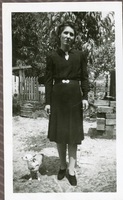
Mrs. Hines of First Baptist Church
Mrs. Hines of First Baptist Church stands posed outside wearing a Black dress with white accent on the belt and neckline and long sleeves. She has a serious expression. First Baptist Church was a predominantly white congregation that had a close relationship with the Mexican American Baptist church in South Colton where Ernie Garcia grew up. -
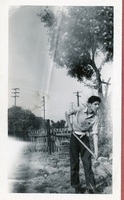
Ernie Garcia working in Garden
Black and white photo of Ernie Garcia working in the garden in South Colton in 1945. -
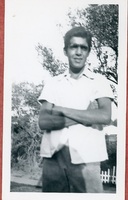
Ernie Garcia Portrait 1945
Ernie Garcia is standing in a yard in front of a tree in Colton 1945 as an older teenager. -
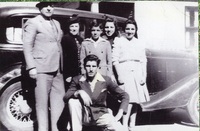
Garcia family with car
Parents Appollonio and Lupita are pictured with their children Eva, Hilda and David in front of their car in South Colton. -
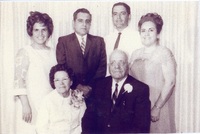
Garcia Family Portrait 1958
A black and white formal portrait of the Garcia family in 1958 with adult childen. Parents Guadalupe "Lupita" and Apollonio "Polo" Garcia are in the front with children from left to right including Eva, David, Ernie and Hilda. The family is all dressed in suits and smiling for the camera. The Garcias lived in South Colton and were prominent members of the local Baptist church which they joined when they arrived in the 1920s.