-

Color portrait of Travis Greene in Marines uniform. Travis eventually retired from the Marines.
-
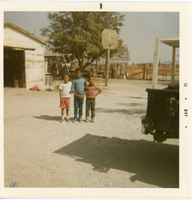
Color photograph of three children standing with their arms linked and smiling at the camera. They are standing outside in a gravel area at the Greene Family house.
-
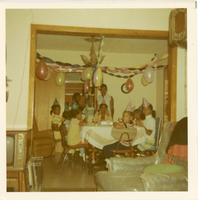
Color photograph of a birthday party taking place in Grace Greene's dining room. There are pink, yellow and blue streamers hanging from the ceiling and a group of children wearing party hats sit around the table, some smile at the camera.
-
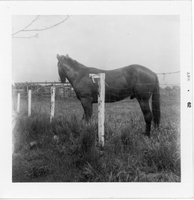
Black and white photograph of a horse looking away from the camera and standing behind a fence in a field. "APR 62" is printed on the right side of the photo, indicating the photo was taken in April of 1962.
-
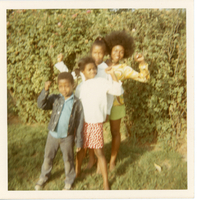
Color photograph of the Greene children, standing in a line outside on the grass doing the Black Power sign, which is a raised fist, palm facing out.
-
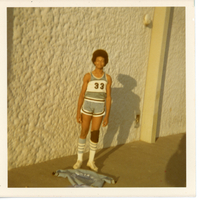
Color photograph of Edmund Greene in his basketball uniform posing for the photo in front of a white wall outside. His jacket is on the floor in front of him, and has number "33" on the chest of his uniform.
-
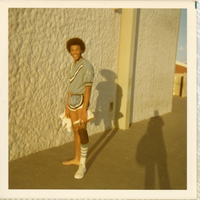
Color photograph of Robert Thomas standing outside in front of a while wall smiling at the camera. Robert is wearing a light blue basketball uniform with number "13" printed on the arm of the shirt. Robert is wearing one of his white Converse tennis shoes on his foot, and holding the other shoe and socks in his hands.
-
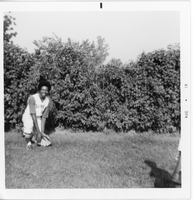
Black and white photograph of Edmund Greene smiling in his baseball uniform outside in the grass in front of a bush. Edmund is on one knee, and leans forward with both of his hands holding his baseball glove on the ground.
-
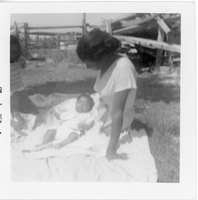
Black and white photograph of Grace Greene sitting down outside on the grass with an infant in her lap, and a young child to her left. "AUG 60" is barely visible printed on the left edge of the photograph, indicating the photograph was taken in August of 1960.
-
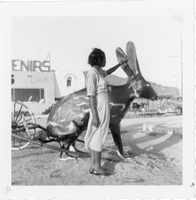
Black and white photograph of a Grace Greene standing outside, facing away from the camera with her arm outreached to touch a large rabbit statue.
-
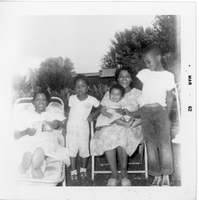
A black and white Greene family photo in the backyard with most likely Aunt Augustine and another woman, a boy, and two girls. Right to left is Edmund Greene, woman with baby, Wanda Greene and unknown woman, Corn is growing in the background -- probably in south. Not valleyWith the description "Mar 62" for the date March 1962.
-
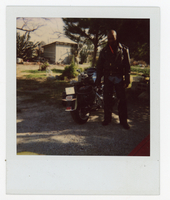
Travis Greene at his mother Grace Greene's house on Foisy in the Valley is posing next to his motorcycle.
-
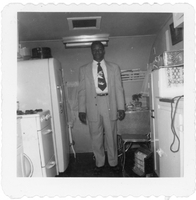
Eddie Greene in the kitchen of trailer on the land they bought on Foisy before they built the house. He is staring at the camera, wearing a suit and tie.
-
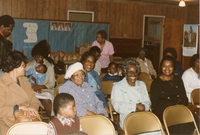
Color photograph of Mrs Benton smiling in pale blue as she sits in the backroom of St. Mark's Missionary Baptist Church next to Grace Greene, dressed in all black to her right. The two were neighbors on Foisy. Around them other members of the congregation are seated.
-
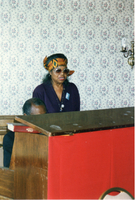
Harrison Crump on piano and Grace Greene singing perhaps at his house where they would practice for concerts. He was the longtime pianist at St Mark's Missionary Baptist Churcy, and Grace Greene used to sing opera in two churches.
-
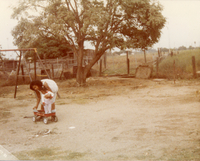
Grace Greene with granddaughter Tasonya in backyard with a clear view of the rural properties behind their home on Foisy where the Green extended family had property.
-
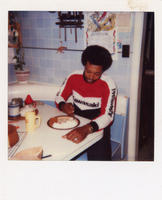
Color photograph of Edmund Greene in his 20s sitting at his mom's kitchen table wearing a Kawasaki motorcycle shirt.
-
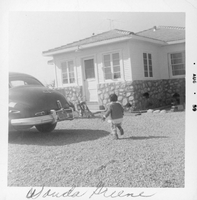
Black and white film photograph of a young Wanda Greene taken from behind, outside of a house. There are a bicycle and a car parked in front of the house. "AUG 59" is printed on the right side of the photo, indicating the photo was taken August of 1959, and on the bottom someone has hand written "Wanda Greene" in cursive.
-
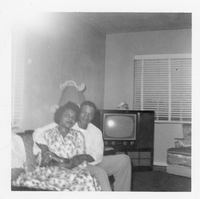
Black and white photograph of Eddie and Grace Greene, sitting on a couch inside of a living room, with the TV behind them. Grace is wearing a floral dress and sits in front of Eddie, who has his arms wrapped around her. They both smile at the camera.
-
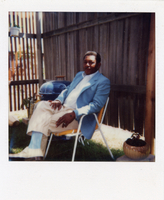
Color photograph of Eddie Green sitting in a lawn chair outside wearing a blue suit jacket. Behind him a is wooden fence and blue grill.
-
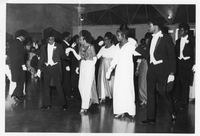
Black and white photo of Parents Dance from the Beautillion Ball. Grace Greene and Edmund Greene on right.
-
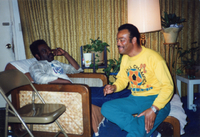
Color photograph of Oliver Sr. in a plaid top resting on a couch. Next to him is a man in a bright yellow sweater that says "Ball Champion England 02" and is wearing a silver watch and teal bottoms.
-
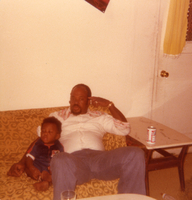
Color photograph of Oscar Overstreet in a white top and wearing a gold watch. To his right is a can of soda on a coffee table and to his left under his arm is a young Demetri McMurray. They are both sitting on a yellow patterned couch.
-
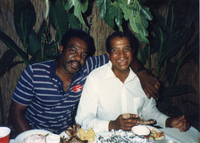
Color photograph of Oliver "Wendell" McMurray (left) and Trevor Coleman (right). Oliver is in a dark blue striped shirt which has a Marlboro box in it's pocket, and has his left arm draped around Trevor's shoulder. Trevor is in a white dress top.
-
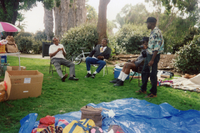
Patrick, George, Wendell and Trevor are pictured having a chat while they sit on lounge chairs. Around them are various objects such as a pink and white umbrella, black and pink soccer ball, and a bicycle behind them.