-
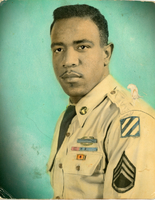
Aniceto grew up around a Latino community in Redlands. Many of his friends from the neighborhood were Latinos and shared similar interests. Some of Aniceto’s memories describe, dances organized for the youth, local clubs, and sports events within Redlands. He explains how large groups of people would travel from Los Angeles, or other areas, to watch baseball games in Redlands. On the other hand, he also mentions how he faced discrimination in elementary school for not being able to speak English. He was not allowed to attend elementary school until he learned how to speak English. In addition, due to financial problems within his family, Aniceto had to leave high school at fifteen years old. He was also discriminated when he attempted to join the Navy. He explains that he joined the Army because the Navy did not accept Latinos. His experience in WWII was difficult. He was met with many challenges while at war. He remembers D-Day and the events of that day. He remembers the ocean turning red from all the blood. Aniceto almost lost his life on D-Day. He almost drowned in the ocean due to the heavy equipment he was carrying. He was also suffered an injury a few days later while he was keeping watch.
-
1995 interview with Joe Gonzales Jr.
-
1998 interview with Joe Arredondo, his daughter Evelyn Pedro is present and fills in small details missed by Mr. Arredondo. Arredondo speaks on his working life: being a citrus grower, running a picking crew, hauling citrus, being on the board at the East Highlands citrus packinghouse, and being the secretary/treasurer at the Greenspot Water Company. He also recounts his family history, when his father came to the US and time spent with his grandfather. Anecdotes related to life during and after the Great Depression as well as interactions with braceros are also told.
-
1994 interview with Gerald Garcia. Gerard Garcia and their wife Mary discuss their family history with the orange citrus industry in Redlands. They touch on the shifts in the industry through time, from the Bracero program to owning their ranch.
-
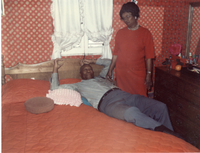
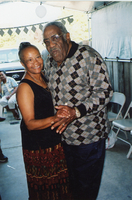
Mr. and Mrs. Hernandez stand posing for a portrait photo. Tony is seated and his wife is standing beside him.
-
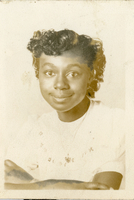
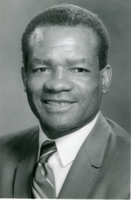
Black and white portrait of Lucille Hernandez-Ortiz.
-
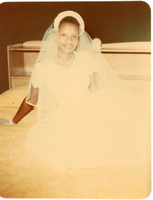
Toti Lozano stands posing in what appears to be her wedding gown. Another person in formal wear stands behind her, with their hands on her shoulders.
-
2009 Month of April Calendar. In the bottom left corner is an advertisment that reads: State Farm providing Insurance and Financial Services Home Office, Bloomington, Illinois 61710, 24 hour good neighbor service, Yolanda Vasquez-Meier, Agent, Lic #0721892, 935 S. Mt. Vernon Ave. Suite 108, Colton, Ca. 92324, 909-370-4595 Fax: 909-370-0467, yolandavasquezmeier.com, Hablamos Espanol". In the bottom right corner is an advertisement that reads: "MDS Transaction Service, Yolanda Venegas, 6841 Ironwood Dr. Riverside, Ca. 92506, Ph:951-780-4030 Fx:951-780-3586 Cell:951-215-5202 E-mail: yrvenegas@sbcglobal.net". Holidays listed on the calendar include: April Fools Day, Wednesday April 1st; Palm Sunday, April 5th; Passover, Wednesday April 8th; Good Friday, April 10th; Easter, April 10th; Earth Day, April 22nd.
-
Jenny Ybarra reflects on the rich history of her family’s ownership of Ybarra’s Market and their experiences living in Westside San Bernardino from the 1920s to the time of this interview. Jenny’s parents migrated from Guanajato, Mexico and established themselves in San Bernardino in April of 1927. In 1946 they bought Ybarra’s Market and ran it until Raul Raya took it over; he sold it in 2023. During their time owning Ybarra’s Market, it was more than a business; it was a lifeline to the Westside community. Ybarra’s Market allowed customers to shop on credit, allowing families to put food on the table when they needed it the most. This trust would go on to build customer loyalty and would keep customers coming back to the market, even when the 215 freeway isolated Ybarra’s Market from the community. Jenny emphasizes her gratitude to loyal customers and to members of the community who still remember their time at Ybarra’s Market. She also ends the interview with a heartfelt message about her parents and their impact on Westside.
-
Fernanda Durazo, a photographer and Bloomington resident, discusses the critical issues facing the community. Increasing development of warehouses in Bloomington is the central theme. She addresses the rapid industrial development and rezoning (from residential to industrial/commercial) that displaces homes, schools, and rural land, affecting the quality of life and the environment. She talks about Howard Industrial Partners' role in offering the county an exchange: if they can demolish the existing Zimmerman Elementary School, then Howard will rebuild it elsewhere. Durazo talks about her goals for her photographs to capture these changes, preserving the neighborhood’s history and highlighting challenges posed by industrial expansion. The interview also addresses the role of Bloomington Municipal Advisory Council and critiques Joe Baca Jr., the county supervisor overseeing Bloomington, for approving warehouse projects without community consultation.
-
Margaret Razo is a longtime Bloomington, California resident who moved to the area in 1973 from Riverside. She narrates her family history and experiences in the originally rural area with tight-knit neighbors. She describes her upbringing and community involvement due to her father’s emphasis on making everyone feel included. Kessler Park was a staple of her childhood as she mentions get togethers and baseball games there. Over the years, industrialization begins to impact the once peaceful and simple area with an influx of warehouses and infrastructures that begin to displace lifelong residents, forcing them to relocate. Her concerns reveal the effects of warehouse and other industrial growth on well-established communities and the rural environment.
-
This is an oral history interview with Reverend Benita Ramsey conducted on January 10, 2024. This interview covers Benita's childhood in Liberty City (a suburb in Miami, FL), her religious upbringing, her educational journey through law school at the University of Miami School of Law, and her continued involvement in LGBTQ advocacy and community work as a minister to the Unity Fellowship Church, based out of Riverside, California.
-
This is an oral history interview with Judge Virginia Phillips conducted on February 21, 2024. In this interview, Judge Phillips shares her childhood upbrining in Orange, California, and how she studied at UC Riverside before pursuing a law degree and eventually becoming a judge. The main highlight in this interview was Judge Phillips sharing her story on how she struck down the Don't Ask, Don't Tell policy in the United States military, altering the way that the LGBTQ+ community serves in the military today. Phillips also reflects on her active role in the community within Riverside and the Inland Empire and her commitment to her service within the community as a judge.
-
This is an oral history interview with Gabriel Maldonado conducted on April 4, 2024. In this interview, Gabriel shares his life story starting with his childhood as a bi-racial African American and Latino boy in Compton, CA. He emphasizes his work as an LGBTQ+ advocate in the Inland Empire, his connection to Riverside and the community he's built, and all the moments that led him to become an activist. He also emphasizes his role as the CEO of TruEvolution, an organization based out of the IE that is dedicated to fighting for health equity and racial justice. Maldonado mentions his work in spreading HIV awareness through his work both in the community and on the Advisory Council on HIV/AIDs for the Obama administration.
-
This is an oral history interview with Connie Confer, conducted on December 15, 2023. Connie, whose full name is Carolun Confer but is commonly known as Connie, shares her life story from her childhood in Milton, Pennsylvania, her family background, her education at Penn State where she majored in broadcasting and theater arts, and her career as a social worker, her path to law school, and later becoming an activist for LGBTQ rights with her long-term partner/wife Kay.
-
This interview with Robert Bland was conducted on November 8, 2023. In this interview, Bland discusses his early life growing up in segregated Virgina and his experiences as one of the first African American undergraduates at the University of Virgina in the 1950s and eventually moving to California in the 1960s. Bland describes his community activism in Riverside as one in which he was an active member for the local NAACP chapter, where he served as the education chair and collaborated with other local organizers to create Freedom Schools as an alternative to the public school system during a boycott. Towards the end of the interview, Bland discusses his current involvement in issues of public safety and criminal justice reform and expresses hope that the next generation will continue the fight for equality and justice that he and his community have championed.
-
This interview with Dr. Deborah Wong, conducted on May 8, 2024, explores her life and work as an ethnomusicologist and social justice advocate. Born in New York City in 1959 to a Chinese-American father and white-American mother, Dr. Wong reflects on her multicultural upbringing and the racial dynamics she experienced while growing up on the East Coast and in Richmond, Virginia. Her academic path began with a love for music, leading her to ethnomusicology, which allowed her to study music in its cultural and social context. After earning her PhD, Dr. Wong taught at Pomona College before joining UC Riverside in 1996, where she focused on Asian American performance and music as tools for community building and racial justice. Her research includes documenting Riverside's Asian American history, preserving the city's Chinatown, and serving on the Riverside Coalition for Police Accountability following the 1998 police killing of Tyisha Miller. Dr. Wong emphasizes the power of music in shaping identity and social change, especially within marginalized communities. She continues to champion public-facing research and activism, hoping her work will inspire future generations to build on the legacy of community-based justice and equity.
-
-
This interview with Rose Mayes was conducted on December 5th, 2023. In this interview, Rose shares her life journey, growing up in Millville, Louisiana to moving to Riverside and establishing multiple organizations that advocate for social justice and fair housing. Rose begins by sharing stories of her childhood, being one of fourteen childreen and growing up with a close-knit family. She moved from Louisiana to Texas where she graduated high school and eventually started her own store, "Rose's Record Store" which became successful in Houston. It was during this time she navigated racial discrimination in business. After selling her business, Rose moved to Riverside where she earned her bachelor's and master's degree in business, worked for the Wall Street Journal, and became involved in activism. Rose became the executive director of the Fair Housing Council in Riverside County, fighting against housing discrimination, organizing out reach programs, and providing education on home ownership. Rose also founded the Eleanor Jean Grier Leadership Academy in 2007 to train community members to servce in leadership roles, such as city boards. Rose is still committed to serving the city of Riverside, citing the Dr. Martin Luther King monument site as another project she is currently working on.
-
This is an oral history interview with Justice Richard T. Fields conducted on November 15, 2023. The interview covers his childhood memories from growing up in East St. Louis, Illinois and his experiences with racial discrimination growing up in a racially segregated community. His interview also covers the impact of his role in the community from being a lawyer to become the Associate Justice on the California Court of Appeal, Fourth Appellate District, Division Two.
-
This interview with Bernell Butler was conducted on March 27, 2024. In this interview, Reverend Bernell Butler describes growing up in the Belltown neighborhood of Riverside, California, his military service, and eventual calling into the ministry. He recounts the tragic circumstances around the death of his niece, Tyisha Miller, who was killed by police in 1998. Butler discusses the community's outrage and protests and the challenges he faced in mobilizing support and seeking justice, as Tyisha's story made national headlines and garnered the support of African American leaders like Jesse Jackson and Al Sharpton. Butler organized multiple actions for his niece, including a freeway nonviolent protest, and became the spokesperson for the family and continued to advocate for police accountability and community care.
-
-
This transcription of Lalit Acharya gives a detailed account of his experience as an immigrant in Riverside, California and his involvement with the community. Lalit is the president of the Ghandi Foundation in Riverside and board member of the Civil Rights Institute of Inland Southern California. Lalit shares the process of getting the Ghandi monument to Riverside, while also sharing the history of the Harada House, another notable historic site in Riverside that was the home of Jukichi and Ken Haradan and how the house was involved in a longstanding legal battle with the city of Riverside to reclaim the property. The rest of the transcription has Lalit describe his personal journey with his involvement in the Riverside community and community involvement.
-
This interview with Congressman Mark Takano was conducted on March 15, 2024. Takano's interview covers his childhood growing up in Riverside, his family's history of Japanese incarceration during World War II, and his journey into politics. Takano shares that he grew up in the La Sierra, Arlington side of Riverside and his mom worked as a school secretary at North High School. It was through his high school experience that Takano grew an interest in public service and cites that as the beginning of his political journey. When running for State Assembly in 1994, Takano was outed by his opponent. Since then, Takano discusses the progress made on LGBTQ+ rights durings during his tenure in Congress. The rest of the interview discusses one of Takano's major legislative accomplishments, the PACT Act, which expanded benefits for veterans exposed to toxic substances, the Blue Water Navy Act, and the Compact Act for veteran mental health services.
-