-
This interview with Dr. Judy White was conducted on April 10, 2024. In this interview, Dr. White talks about her childhood being born in Los Angeles in 1955 and growing up in San Bernardino and later attending Occidental College, Cal State San Bernardino, UC Irvine, UC Riverside, and Azusa Pacific, where she received her doctorate. Dr. White details the initiatives and projects that she was instrumental to like the Asterisk Project, AAPAC, and others that have shaped education across the state of California.
-
This interview with Eloise Gomez Reyes was conducted on March 22, 2024. Reyes is a California State Assembly member representing the Inland Empire region. In this interview, Reyes talks about her upbringing in a close-knit Latina/o/x community in Colton, her love for education, and how that led her to become the first in her family to attend USC and eventually pursuing a career in law and becoming the Assembly Majority Leader for the California State Assembly.
-
This interview with Katie Greene was conducted on December 5th, 2023. Greene is primarily known in the community as co-founder of The Group, a Riverside-based organization that was founded in 1999 to address issues affecting the African American Community. As the longtime chair of the Issues and Actions committee, Greene has been a long-term community advocate, building with the Riverside African American Historical Society and the Eleanor Grier Leadership Academy. In this interview, Katie recounts her life, from her childhood in Millville, Louisiana, to her military service as a medic, nurse, and nurse practitioner. While serving in the military, Greene also describes some of the challenges she faced due to her race and gender. One example is her being chosend to model hairstyles for the military's new affirmative action policies. Despite these challenges, Greene also went on to pursure a law degree and volunteered for 23 years with the Public Service Law Corporation which helped those who could not afford legal services. Both Katie and her sister Rose Mayes are a powerful postive force in Riverside, and Katie's interview reflects that.
-
-
This interview with Jane Block was conducted on November 10, 2023. Block is a 94-year old community and environmental advocate and activist from Riverside, California. In this interview, Block recounts her life story, from growing up in a rural Catholic community in Idaho, to moving to Riverside where she became a prominent figure in the local women's rights movement. Through her advocacy, Jane played in active role in founding and leading several organizations in Riverside like the County Childcare Consortium, the Women's Resource Center, and the Commission for Women in Riverside County. Jane also mentioned her work in environmental activism through protecting natural areas like the Santa Rosa Plateau and how she's connected environmental issues and women's rights.
-
This interview with Chani Beeman was conducted on April 10, 2023. Chani Beeman is a prominent community activist that advocates for LGBTQ Rights and police accountability. Born and raised in Riverside, California, Beeman shares her experiences growing up in the Inland Empire and coming to terms with her queer identity. After studying at Riverside Community College, UC Riverside, and Cal State San Bernardino, Beeman discusses her work in community activism, specifically with the Inland Congregations United for Change (ICUC) and her involvement with the Riverside Coalition for Police Accountability, where she worked to ensure transparency and accountability with Riverside law enforcement.
-
This interview with Elvis Zonoroza was conducted on July 12, 2024. The interview covers Elvis's earlier life memories within Mexico and America, and the challenges he faced as a deaf individual. These include challenges with communication with other people and the challnges in aclimating to the new lifestyle he experienced when arriving in the US from Mexico. Elvis discusses his education at the California School of the Deaf. After his highschool graduation at CSDR, Elvis innitially sought to persue a cereer in Physical Education, and so he attended Galaudat University in Washington D.C, but had to leave early due to becoming a young father. Elvis recalls his experience first working with community advocacy, which gave him a new perspective on how to help deaf people. After graduation, he got a job as an ASL instructor at the Holy Names Highschool in Oakland which gave him a more in depth understanding behind ASL and its intricacies. Later on down the line, Elvis worked in the Center on Defeness in the Inland Empire (CODIE) where he advocated on behalf of others with the same condition as he. He advocated for their employment, education, and accimation and acceptance within communities. He continues to advocate using his youtube channel which focuses on sports and sports education as well as deaf education.
-
This interview with Vivian Stancil was conducted on May 7, 2024. Vivian shares her life story, including her challenging childhood in foster care, her diagnosis of retinitis pigmentosa (RP) that led to vision loss, and her perseverance in pursuing education and becoming a teacherin Long Beach.
After retiring from teaching, Vivian was told by her doctor that she would not live to 60 if she did not make significant life changes. From that point, Vivian made a major life style change through swimming as a sport. Through her love for swimming, Vivian dedicated herself to community service, founding two non-profit organizations - Christian Intercessors of the Nations and the Vivian Stancil Olympian Foundation. The Olympian Foundation focuses on drowning prevention, providing free swimming lessons and water safety education, especially for underprivileged children and adults. Vivian herself learned to swim as an adult and went on to compete in the Senior Olympics, winning numerous medals.
-
This interview with Ben Jáuregui was conducted on December 12, 2023. In this interview, Jáuregui shares his upbringing as a child of migrant farmworkers, and how witnessing their challenges eventually led and inspired him to become a disability rights advocate. After taking sign language classes in high school and volunteering at a disability advocacy organization, Jáuregui discusses his work at the Inland Empire Health Plan where he helped make healthcare more accessible for people with disabilities. Jáuregui also talks about his leadership roles in initiatives like the Inland Empire Disabilities Collaborative and the Inland Coalition on Aging, which aim to improve services and support for seniors and individuals with disabilities in the IE.
-
This interview with Phyllis Clark was conducted on May 10, 2024. Clark is the founder and CEO of the Healthy Heritage movement, a non-profit organization focused on eliminating health disparities in the African American community. In this interview, Clark shares her experience growing up in a military family, her educational career in fashion and business, and how that eventually transitioned into health advocacy work. Through the Healthy Heritage Movement, Clark shares more about programs like Broken Crayons Still Color that showcase a holistic approach to health advocacy amongst the African American community.
-
This interview with Pete Benavidez was conducted on January 12, 2024. Benavidez recounts his life as someone with low or no vision, being diagnosed with retinitis pigmentosa (RP) at a young age and how this experience influenced him to become one of the leading disability rights advocates and activists in the Inland Empire. After moving and settling in Riverside, California, Benavidez eventually founded Blindness Support Services, a nonprofit organization that provides servides and support for individuals with low or no vision.
-
This interview highlights the challenges of running a small business in San Bernardino, which Raul Raya and his family have done for several generations. Raya discusses Ybarra’s Market, the transformations he has seen in the city, and the impacts of freeway construction on both the business and the larger Westside San Bernardino community. He explains that due to the construction of the 215 freeway in the 1960s (originally named 395), and the placement of exits directing the flow of people away from the Westside, businesses like his declined. Mt. Vernon Avenue -- once the city’s commercial and business corridor along historic Route 66 -- became desolate in the years and decades following the freeway’s opening. The freeway blocked cross traffic. He mentions that before the freeway and before the closures of the Norton Air Force base and Kaiser Steel, his family-owned business was doing well. The loss of jobs due to those closures made it hard for families, and his shop, to survive economically. The interview also discusses the 10 Freeway, which was one of the only routes to San Bernardino, and the importance of Route 66 to the city. Raya says that as time passed after the freeways were completed, those businesses began to shut down and numerous small stores such as his own were forced to sell. Raya further discusses the amount of work and money that has been invested into the store to maintain and follow code enforcement, and how the low profit margins make it difficult. As the interview ends, Raya discusses his belief that the city did not think of them before the freeway construction nor did they after, and as a result, the local businesses declined with little chance to prosper.
-
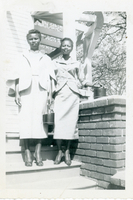
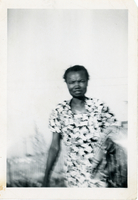
The childhood house of Janice Wilson was located at 24618 Norman Road. Janice's family moved to this house when she was only 4 or 5 years old in the mid-1950s, having previously lived in a tiny shack in Los Angeles. A unidentified women stands on the front steps of the house.
-
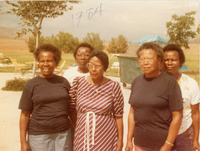
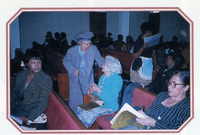
A group of women dressed up as if for church in a color photo, possibly a church mission group. Mrs Marshall is in the back in light blue dress, light blue in front right is Mrs Wilcots, dark blue Mrs Henchen. Other women not yet identified.
-
2024.012.028 Family reunion at Beatrice Wilcots' house on Norman Road. "Sister Beatrice Wilcots, left, arrived at St. Mark’s in 1959, having followed her husband, Rev. D.E. Wilcots, who came prior to that. Sister Wilcots served as a Sunday school teacher, VBS teacher, and as president of the missionary society. She said that Christ is all she needs or wants in life, and He is who she depended on. She advised people to accept Christ early so they would have Him to direct their paths." (Truck Valley Farms Scrapbook, 2019).
-
Miss MacDay's house on Norman Road, known for her field of blackberries that she allowed children to pick and eat.
-
Woman holding a big fish, perhaps as a gift to a neighbor. She is accompanied by a group of three men and an unidentified man is walking with their grandchild. Another unidentified man stands to the far right, holding a fishing pole and staring at the camera.
-
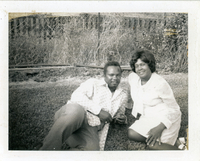
Smiling Pastor Freeman Williams and wife Mrs. Lucille Williams dressed in their formal church attire to attend St. Mark's Missionary Baptist Church in May of 1956.
-
4 children sit on the bumper of a 1940s car on a street in Norman road. They are barefoot. From left to right: Garfield Henchen, Janice Wilson, Larry Harper, and Michael Harper.
-
Churchgoers seated in pews of the St. Mark's Missionary Baptist Church honor Mrs. Blanchette (in usher uniform) as she is escorted down the middle aisle by two young unidentified women.
-
This image captures the January 1961 Women's Missionary Meeting. The women are gathered in a room, posing for the camera.
-
An unidentified woman stands in their backyard hanging laundry on Norman Road. Taken in February 1963.
-
A photo taken in February 1963 depicting a neighbor's house on Norman Road.
-
Sister Beatrice Wilcots is pictured in the middle, Effie Hinchen is standing, and Mrs. Thomas is on the right (Valley Truck Farms, 2019). They are at a February 1961 missionary meeting, likely celebrating a birthday given that two of the women are wearing party hats. The image reads, "FEB 61."
-
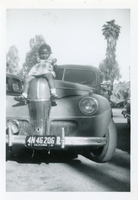
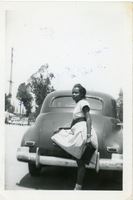
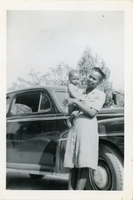
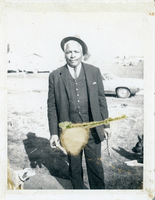
1940s car in front of a neighbor's house possibly on Norman road.