logo

Explore the growing digital archive of A People’s History of the I.E.

Over 1,020 items are at your fingertips. Scroll the list below, view our individual collections, use the search bar, or explore collection highlights.

Popular Searches:
World War II, Packing houses (and perhaps also Packinghouses), Mexican American History, Local Businesses

Quick Search Tips:

Explore the complete Inland Mexican Heritage Digital Archive.

  • Sala Ponnech Oral History

    This interview details Sala Ponnech's involvement with union organizing efforts at UC Riverside in the 1970s and 1980s. As a young clerical worker, Sala became the chair of the local CSEA chapter, working closely with other activists like Lorraine Klein, Gladys Murphy, and Margaret Ellis. They faced challenges from management and competing unions like AFSCME, but were able to provide representation and support to many employees facing discipline or termination. However, the CSEA ultimately withdrew from the organizing effort, leaving AFSCME and other unions to compete for representation. Sala reflects on the power dynamics, gender dynamics, and political tensions that shaped the union organizing on campus during this period.
  • CeeAnn Thiel Oral History

    This oral history with CeeAnn Thiel explores her life, family background, and decades-long career as a small business owner in Riverside, California. CeeAnn recounts growing up on a large potato farm in Idaho as one of fourteen children, emphasizing how farm labor instilled a strong work ethic that later shaped her entrepreneurial success. She describes moving to Riverside about forty years ago, initially for her husband’s education, and eventually opening her own shop, Mrs. Tiggy Winkle’s. A central theme of the interview is family, both her upbringing and her collaboration with her sisters who also operated businesses in downtown Riverside, including the Windhover House and Simple Simon’s. The interview also provides insight into the evolution of downtown, particularly the Mission Inn area in the 1980s and 1990s. CeeAnn talks about her retail space initially inside the Mission Inn and now on the nearby pedestrian mall, and contrasts the area’s earlier, more intimate and eclectic character with later redevelopment into a more commercialized space. She discusses changes in retail over time, including shifts in sourcing, consumer trends, and the decline of independent shops. Overall, she credits her longevity to her adaptability, loyal customer base, and intuition.
  • Michiko Yoshimura Oral History

    Michiko Yoshimura was born on January 22, 1941 in the San Gabriel Valley before she and her family were incarcerated at Heart Mountain and Tule Lake. After their incarceration, in the early 1950s, her family moved to West Riverside. During this time, her family ran a successful fruit stand which she helped with. Growing up, she brought her sisters to Japanese language classes in Casablanca and attended church events at the Japanese Union Church because it was a central place for the Japanese American community. Michiko graduated from Poly High School and studied education at the University of California, Riverside. At the time, she noted women could only be secretaries, nurses, or teachers. Michiko taught in the Riverside Unified School District for 36 years at three different elementary schools. Oftentimes, at these educational institutions, she was the only Japanese American person in her classes. She noted how she wanted to blend in and not stand out. She described where different Japanese American farms were and the racial make-up of different parts of the city. Also, she got involved in the Riverside chapter of the Japanese American Citizens League (JACL) helping with the Sendai Festival, Thanksgiving, and summer picnics. Michiko has maintained the records and photos from her family and has collaborated with the Harada House, UCR, Save Our Chinatown Committee for cultural and historic preservation.
  • Meiko Inaba Oral History

    Meiko Inaba was born in 1938 in Hollywood, California. She was about 4 years old when she was incarcerated at the Santa Anita Racetrack, later being transferred to Heart Mountain, Wyoming. From there, she grew up in Gardena until she went to study at UCLA and briefly taught for a while before moving to Riverside after she got married in 1961 to Mitsuru Inaba. When she first moved to Riverside to the Inaba farm, it was a big change from her life in the Los Angeles area, and she talked about how isolating it was. When she moved into her current home, she was met with racial discrimination regarding the housing prices and vandalism that depicted racial slurs. Later, she got involved with the Japanese American community through her children' s schooling through the PTA, later meeting Sumi Harada and getting involved with the Riverside chapter of the Japanese American Citizens League (JACL). She helped the JACL in preparing for the Sendai festival, Thanksgiving, Christmas parties, and Easter Egg Hunts for the community. She is also very active in historic and cultural preservation. Her father-in-law had saved a lot of the documents associated with the Inaba property as well as photos, and she was able to donate some of the materials to the Harada House and UCR.
  • OlaFaye Stephen Oral History

    This oral history documents Ola Faye Washington Stephens' experiences with systemic racism in Riverside, California from 1960 onward. Despite being told California was a "land of milk and honey" without segregation, she encountered pervasive discrimination: realtors steered her family exclusively to the segregated East Side; her pharmacist husband faced customers refusing service from a Black professional; and she was denied restroom access while nine months pregnant. The interview reveals how segregation concentrated the Black population in overcrowded East Side neighborhoods, limiting housing and employment opportunities. She describes her fear for her children in terms of policing and racism, and how she sent them to a private Christian school; all of them went to historically Black colleges and did not return to Riverside, which she was glad for. Stephens describes her engagement in many community organizations for civil rights, ranging from the Urban League to the formation of The Group, which brought politicians and other people together to “talk about the real issues of Riverside.”
  • Judith Auth Oral History

    Judith Auth is a librarian and community activist who spent 35 years (1971-2006) at the Riverside Public Library, rising from children's librarian to director. Born in Upland in 1943 to French immigrant heritage, she moved to Riverside after earning her MLIS from UCLA. Her career encompassed managing 27 county branches and overseeing the library's transition to digital catalogs. Beyond her professional role, Auth was deeply engaged in Riverside's social justice movements. She served as secretary of Nosotros, a fine arts workshop led by activist Lear Larkins, supporting youth programs and civil rights initiatives. She also worked with the Inland Agency addressing gun violence on the East Side and helped preserve Evergreen Memorial Historic Cemetery as a historical resource. Auth co-founded Inlandia, celebrating regional writers, and remains active with the League of Women Voters, advocating for voter access and community engagement.
  • Frank Acosta Oral History

    Frank Acosta is a retired educator who worked as a junior high teacher for 41 years within the Colton Unified School District. He now serves as a member of the board at the Colton Area Museum, and as one of the three members of the South Colton Oral History Project. Frank grew up in City Terrace, East Los Angeles and moved to the Inland Empire to attend UC Riverside for college. In his interview, Frank shares his experience as an educator in the Colton School District, racial segregation in schools, and the impacts social and environmental impacts of the development of the railroad and later the freeways through the area.
  • Oscar Colunga Oral History

    Oscar Colunga shares his life story, starting from his birth during an unexpected snowstorm in San Bernardino, California in 1949. He delves into his family history, especially his parents’ life after the Second World War and their emigration to South Colton. He describes his childhood in a Mexican American neighborhood and the culture and society of the 1950s and 1960s. He reflects on his school days, recreational activities, and integration, especially during high school, and his participation in different activities outside school. He addresses aspects of his relatives work in the Colton Cement Plant (California Portland), the explosions at the mines he could hear and see from his house, and the ways the dust got into everything and worsened the air quality. Colunga makes keen points about the ways the dust caused health problems among family members, and the respiratory issues they faced. Colunga also talks about the progression of his career, resulting in his decision to move to Solvang, CA. Looking back at the changes in the decades he has been away, he explains how he wants to retire back to his hometown.
  • Ramona Arranda Genamaras Oral History

    In her oral history interview, Ramona Arranda Genamaras shares the story of how her parents immigrated to the United States due to the expanding railroad in Southern California and job opportunities it presented. Ramona is the first born of her siblings, born in San Bernardino, CA, where they lived a few years before moving to South Colton. She recalls growing up in South Colton, attending segregated primary and elementary schools. While she spoke Spanish and English at home, she was expected to only speak English at school, something she remembers understanding without needing to be told. Throughout her years in school, some of her happiest years she recalls, she was very involved in activities and was often asked by her teachers to speak or perform at school events. She remained active in her children’s lives by joining the PTA and organizing the first Halloween carnival, where she sewed costumes for her children. Ramona worked in the garment industry for 15 years as a seamstress, a skill she picked up from her mother who sewed all of her and her siblings’ clothes. This was a practice Ramona herself continued with her own four daughters and one son. Ramona shares the lives of her parents, children, her love for baseball, celebrating her 99th birthday, and community life in South Colton, CA.
  • Mrs. Hines of First Baptist Church

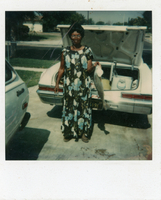
    Mrs. Hines of First Baptist Church stands posed outside wearing a Black dress with white accent on the belt and neckline and long sleeves. She has a serious expression. First Baptist Church was a predominantly white congregation that had a close relationship with the Mexican American Baptist church in South Colton where Ernie Garcia grew up.
  • Ernie Garcia Colton High ID

    Ernie Garcia ID from Colton High reunion
  • Ernie Garcia

    Black and white photograph of Ernie Garcia standing in front of a door car door.
  • Thousand Pines Baptist Youth Camp

    Black and white photo of the Thousand Pines Youth Camp in the early 1940s. Ernie Garcia is in the back row, second from the left.
  • Ernie Garcia working in Garden

    Black and white photo of Ernie Garcia working in the garden in South Colton in 1945.
  • Ernie Garcia Portrait 1945

    Ernie Garcia is standing in a yard in front of a tree in Colton 1945 as an older teenager.
  • Garcia family with car

    Parents Appollonio and Lupita are pictured with their children Eva, Hilda and David in front of their car in South Colton.
  • Ernie Garcia with Cousins

    Ernie Garcia (left) pictured with his cousins Felix Ramirez and Dan Ramirez as older adults. They are smiling, dressed casually in t-shirts and a Hawaiian shirt in front of a wood paneled and brick wall.
  • Garcia Family Portrait 1958

    A black and white formal portrait of the Garcia family in 1958 with adult childen. Parents Guadalupe "Lupita" and Apollonio "Polo" Garcia are in the front with children from left to right including Eva, David, Ernie and Hilda. The family is all dressed in suits and smiling for the camera. The Garcias lived in South Colton and were prominent members of the local Baptist church which they joined when they arrived in the 1920s.
  • Garcia Family Portrait 1948

    A black and white formal portrait of the Garcia family when children are young adults. Parents Guadalupe "Lupita" and Apollonio "Polo" Garcia are in the front with children from left to right including Eva, David, Ernie and Hilda. The family is all dressed in suits and smiling for the camera. The Garcias lived in South Colton and were prominent members of the local Baptist church which they joined when they arrived in the 1920s.
  • Pastor Harper Preaching

    Color photograph taken at St. Mark's Missionary Baptist Church during their Anniversary Celebration. From left to right, Lawrence Hampton, Elvis Brown, David Moore in back, Phil Power, guest speaker from Highland Christian Center and Pastor Harper Preaching at the pulpit.
  • Donald Jackson and Maxine Ramsey

    Color photograph of Donald Jackson handing Maxine Ramsey a Faithful Servant Award for her commitment to St. Mark's Church Anniversary Celebration.
  • Juliette Lynch and Minister Darlow Murray

    Color photograph of Juliette Lynch & Minister Darlow Murray at St. Mark's Church Anniversary Celebration.
  • Dudley Moses and Children

    Color photograph of Dudley Moses and his three adult children at the St. Mark's Church Anniversary Celebration.
  • Choir at Church Anniversary

    Color photograph of the choir at St. Mark's Church Anniversary Celebration.
  • Prayer Circle for Church Anniversary

    Color photograph of members of St. Mark's congregation gathered in a circle holding hands, preparing to say a prayer at the church anniversary celebration.
Browse Collection

logo

Prev Next